
Risk Management · 2025
In this section3 topics
Risk Management Policy & Plan
Policy & Plan Description
Risk Management Policy
Peer For You Public Company Limited recognizes the importance of risk management as a key mechanism to support the achievement of its strategic objectives in an efficient, transparent, and sustainable manner. The Company has established a comprehensive risk management policy covering all business units and integrating it into business operations, corporate governance, and internal control systems.
The Company adopts a proactive approach to risk management, encompassing the identification, assessment, mitigation, and monitoring of key risks at both the enterprise and business unit levels, in order to minimize the likelihood and impact of uncertainties arising from business operations.
Objectives of Risk Management
To support the achievement of the Company’s business and strategic objectives
To prevent and mitigate potential risks and their impacts
To enhance confidence among all stakeholders
To support sustainable and stable business growth
Risk Management Framework and Process
The Company has established a risk management process consisting of four key steps:
1. Risk Identification
Covers risks across strategic, operational, financial, legal, information technology, and information security aspects.
2. Risk Assessment
Evaluates the likelihood and impact of risks and prioritizes them accordingly.
3. Risk Mitigation
Defines appropriate risk management approaches, including risk avoidance, reduction, transfer, or acceptance, along with internal control measures.
4. Monitoring & Reporting
Continuously monitors risk management performance and reports to management and the Board of Directors.
Risk Management Plan by Business Segment
To address risks specific to each business segment, the Company has established the following key risk management approaches:
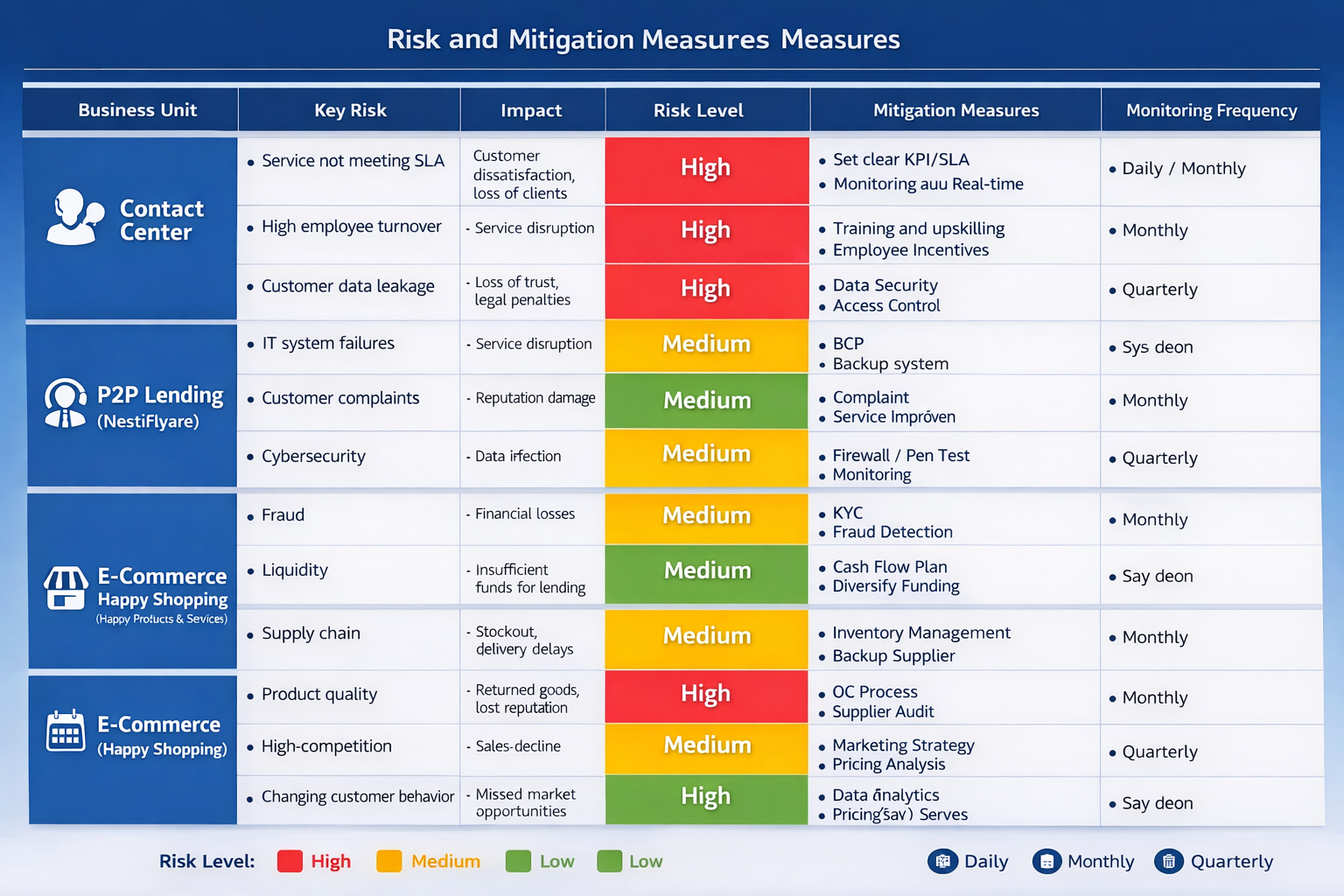
1. Contact Center Business
The Company focuses on:
Establishing and regularly monitoring SLA performance indicators to ensure service quality
Continuously developing Contact Center personnel and managing employee turnover
Implementing personal data protection measures and information security systems
Enhancing IT system stability and maintaining a Business Continuity Plan (BCP)
Managing customer complaints effectively to mitigate reputational risk
2. P2P Lending Business (NestiFly Co., Ltd.)
The Company focuses on:
Developing credit risk assessment systems (Credit Scoring) and debt monitoring processes
Ensuring strict compliance with applicable laws and regulatory requirements
Strengthening IT security systems and cybersecurity measures
Preventing fraud through Know Your Customer (KYC) processes and anomaly detection systems
Managing liquidity and funding sources to ensure sufficient capital for operations
3. E-Commerce / Happy Shopping Business (Happy Products and Services Co., Ltd.)
The Company focuses on:
Efficient supply chain and inventory management
Ensuring product quality and selecting qualified suppliers
Analyzing market trends and consumer behavior to refine competitive strategies
Enhancing platform stability and cybersecurity for online systems
Improving order management and delivery efficiency
Risk Governance Structure
Board of Directors: Oversees risk management policies and the overall framework
Senior Management: Responsible for implementing the policy and managing risks at the organizational level
Business Units and Employees: Responsible for identifying, reporting, and managing risks within their respective areas
Continuous Improvement
The Company is committed to continuously enhancing its risk management system by adopting best practices, leveraging technology, and promoting a risk-aware organizational culture. These efforts aim to improve risk management efficiency and support sustainable business growth.
Policy Document Link
https://www.peerforyou.co.th/wp-content/uploads/2024/10/20241008-Peer_%E0%B8%99%E0%B9%82%E0%B8%A2%E0%B8%9A%E0%B8%B2%E0%B8%A2%E0%B8%81%E0%B8%B2%E0%B8%A3%E0%B8%9A%E0%B8%A3%E0%B8%B4%E0%B8%AB%E0%B8%B2%E0%B8%A3%E0%B8%84%E0%B8%A7%E0%B8%B2%E0%B8%A1%E0%B9%80%E0%B8%AA%E0%B8%B5%E0%B9%88%E0%B8%A2%E0%B8%87-TH.pdf
Risks to the Company's Business Operations
Risk Register
| Risk Name | Risk Characteristics | Consequences | Management Measures | Related Risk Factors |
|---|---|---|---|---|
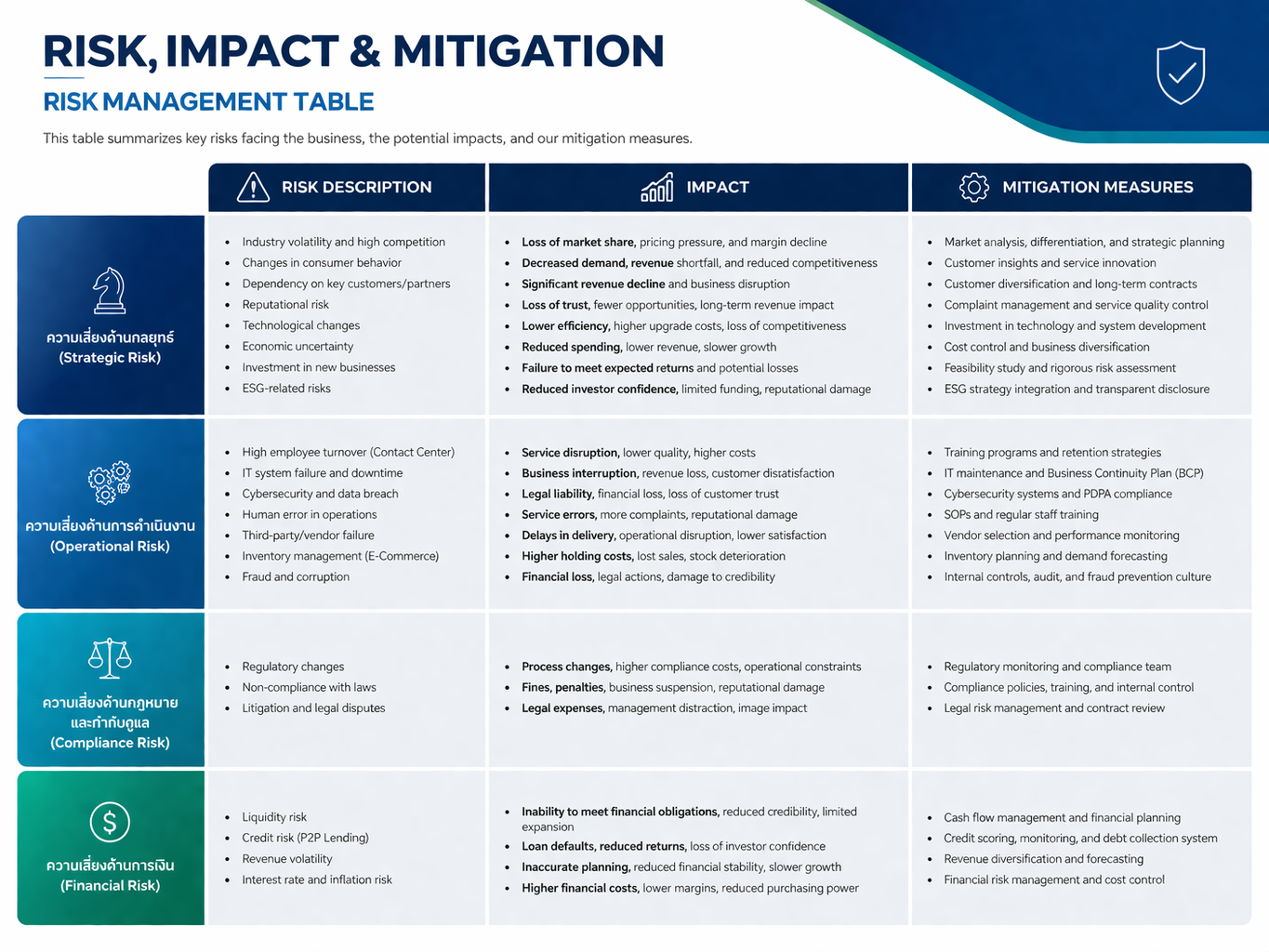
| Risk from Climate Change | Risk Description 1. Strategic Risk1.1 Industry Volatility and Competition 1.2 Changes in Consumer Behavior 1.3 Dependence on Key Customers and Business Partners 1.4 Reputational Risk 1.5 Technological Changes 1.6 Economic Uncertainty 1.7 Risks from Investment in New Businesses 1.8 ESG-Related Risks 2. Operational Risk2.1 Human Resource Dependency 2.2 Information Technology System Risk 2.3 Data Security and Cybersecurity Risk 2.4 Employee Operational Risk 2.5 Third-Party and Contractual Risk 2.6 Inventory Management Risk (E-Commerce) 2.7 Fraud and Corruption Risk 3. Compliance Risk3.1 Regulatory Changes 3.2 Non-Compliance Risk 3.3 Litigation Risk 4. Financial Risk4.1 Liquidity Risk 4.2 Credit Risk (P2P Lending) 4.3 Revenue Volatility 4.4 Interest Rate and Inflation Risk | Impact of Risks 1. Strategic Risk1.1 Industry Volatility and Competition
1.2 Changes in Consumer Behavior
1.3 Dependence on Key Customers and Business Partners
1.4 Reputational Risk
1.5 Technological Changes
1.6 Economic Uncertainty
1.7 Risks from Investment in New Businesses
1.8 ESG-Related Risks
2. Operational Risk2.1 Human Resource Dependency
2.2 Information Technology System Risk
2.3 Data Security and Cybersecurity Risk
2.4 Employee Operational Risk
2.5 Third-Party and Contractual Risk
2.6 Inventory Management Risk (E-Commerce)
2.7 Fraud and Corruption Risk
3. Compliance Risk3.1 Regulatory Changes
3.2 Non-Compliance Risk
3.3 Litigation Risk
4. Financial Risk4.1 Liquidity Risk
4.2 Credit Risk (P2P Lending)
4.3 Revenue Volatility
4.4 Interest Rate and Inflation Risk
| Risk Mitigation Measures 1. Strategic Risk
2. Operational Risk
3. Compliance Risk
4. Financial Risk
| 728 · Description: Volatility in the industry in which the company operates · Info category: STRATEGIC_RISK · 729 · Description: Behavior or needs of customers / consumers · Info category: STRATEGIC_RISK · 730 · Description: Government policy · Info category: STRATEGIC_RISK · 732 · Description: Changes in technologies · Info category: STRATEGIC_RISK · 733 · Description: Business operations of partners in the supply chain · Info category: STRATEGIC_RISK · 734 · Description: Reliance on large customers or few customers · Info category: STRATEGIC_RISK · 735 · Description: Reliance on large partners / distributors or few partners / distributors · Info category: STRATEGIC_RISK · 736 · Description: Damage to company image and reputation · Info category: STRATEGIC_RISK · 1714 · Description: Competition risk · Info category: STRATEGIC_RISK · 1715 · Description: Economic risk · Info category: STRATEGIC_RISK · 1716 · Description: New business risk · Info category: STRATEGIC_RISK · 1717 · Description: ESG risk · Info category: STRATEGIC_RISK · 1718 · Description: Pandemic risk · Info category: STRATEGIC_RISK · 1719 · Description: Climate change and disasters · Info category: STRATEGIC_RISK |
Risks to Securities Holders' Investment
Risk Register
| Risk Name | Risk Characteristics | Consequences | Management Measures | Related Risk Factors |
|---|---|---|---|---|
| Investment risks of Securities Holders | Risk Description 1. Investment Risk of ShareholdersInvestment in the Company’s securities is subject to risks arising from fluctuations in operating performance and overall economic conditions, as well as business-specific factors such as industry competition, changes in consumer behavior, and uncertainty of revenue streams from each business segment. These factors may result in volatility in the Company’s share price. 2. Risk from Major Shareholders (>25% or >50%)The Company may have major shareholders holding a significant proportion of shares, who may influence policy setting, key decision-making, and the overall direction of the Company’s business. This may result in certain decisions not being fully aligned with the interests of minority shareholders. | Impact of Risks 1. Investment Risk of ShareholdersFluctuations in the Company’s operating performance and external economic conditions may result in volatility in the market price of its securities. This could affect investor confidence, trading volume, and the Company’s ability to raise funds from capital markets. 2. Risk from Major Shareholders (>25% / >50%)The concentration of shareholding may lead to decisions that are influenced by major shareholders, potentially limiting the diversity of viewpoints in corporate governance. This may affect transparency, investor confidence, and the protection of minority shareholders’ interests. | Risk Mitigation Measures 1. Investment Risk of Shareholders
2. Risk from Major Shareholders (>25% / >50%)
| 2969 · Description: Risk of the company having a majority shareholder holding > 50% of shares · Info category: HOLDER_RISK · 2970 · Description: Risk of the company having a majority shareholder holding > 25% of shares · Info category: HOLDER_RISK |